Soul Feasts
Tom Brosnahan (Travel Writer)
Focusing mainly on the abstention aspect of the month, people might expect Ramadan to be a rather dreary month; one of piety, of seriousness, something akin to Lent. However unlike Lent, Ramadan is not a month of mourning but of celebration; it is to be a "fast for the body, a feast for the soul."
People fasting for Ramadan will wake up early and have their sahur pre-dawn meal, which often tends to be in the style of a heavier version of the regular Turkish breakfast, eaten with the idea of "stocking up" for a long day without food or water. The standard Turkish breakfast includes bread, butter, jam, honey, olives, tomatoes, cucumbers, cheese, yogurt, preserved meats, fruit juice, perhaps eggs, and tea or coffee. It's often set out as a buffet. Usually at these sahur breakfasts or "start-fasts" there will also be a variety of Turkish pastries and böreks.
In practice, people probably think more about food during Ramadan than any other time of the year; it's the time when housewives pull out all the stops and make their favorite dishes. In the central market in Istanbul's Eminönü, there is almost a festival atmosphere as people search for the best, the freshest, the finest. Families who can, go all out on food shopping, buying special items that are too expensive to be indulged in every day. Ramadan is the time to get the best cheese, the best pastrami, the slightly more expensive fruit and desserts.
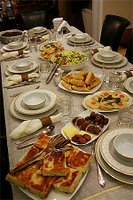 A regular Turkish household will almost every evening have a three course meal that begins with a different type of soup each day. At Ramadan the courses go up to five, with two main courses and various starters and desserts. Though the clerics emphasise, and logically so, that the iftar meal should be light and not an exercise in gluttony, it is traditionally a time to sample the full range of Turkish and Ottoman cuisine. Some households become very inventive, using it as an opportunity to re-introduce old family recipes with modern twists.
However, even though the sunset dinner or iftar sofrası is usually a lavish occasion and an invitation to a Muslim home for iftar can be quite a treat, it is one that is begun simply. The fast is traditionally broken with a date or an olive, and a sip of wate or tea.
Food at Ramadan
The tradition of iftar hasn't changed greatly from Ottoman Empire times and iftar tables can be made up in homes or people may get together in restaurants. After breaking the fast with the customary date or olive, people start the main meal with soup, usually followed by two main meat dishes, one cooked in olive oil and one with rice. Compost made of various fruits and mixed seasonal salads and sweets like revani, kadayif and güllaç complete the meal.
Since the Muslim calendar is a lunar one, Ramadan is a shifting month, and so available ingredients change throughout the year. For this reason there is no set "seasonal" menu for Ramazan as there is in the more stable Christian holidays. Still, there are a few special items without which Ramadan would not be Ramadan in Turkey, and certain regions do have their own Ramadan dishes.
Dates, for example, are something which Turks tend to be oblivious of most of the year. Associated almost exclusively with Ramadan, they are prominently displayed everywhere, in stores, carts on the street and in great piles in the neighborhood markets: nearly round, dry yellow ones from Baghdad, soft black ones from Bam in Iran, large medjool expensive types from Medina with their characteristic waxy bloom, and glistening dark brown ones from Tunisia.
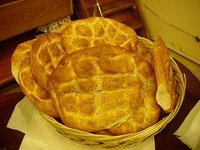 Another sure sign of Ramadan is the rows and rows of Ramadan bread or Ramazan pidesi in the bakeries. This is a special flat round bread about 14 inches wide and perhaps an inch thick at the most, brushed with egg and sprinkled with nigella seed. It's reportedly a very difficult bread to make well, and some bakeries hire a specialist to make it during the month. It's soft, rich and very slightly sweet.
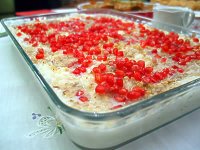 As for desserts, no Ramazan is complete without the aforementioned güllaç. It is based on large wafer-thin starch leaves that are traditionally prepared by hand, of egg whites beaten together with a generous amount of wheat starch. Milk is then boiled with sugar and the starch wafers are dipped into it for about 30 seconds, causing them to soften and become silky smooth. These are then wrapped around a variety of fillings, including nuts, grated apples, marzipan, clotted cream, or a milk pudding. Rose water is sprinkled on top; it is from this that the dish takes its name (gül, rose). The tops are then typically decorated with a sprinkle of pistachios, pomegranate seeds or cut fresh fruit. It's a beautiful looking dessert and, as with most unpretentious food, the best when homemade.
Along with household dinner tables, five star hotels and restaurants also reflect the spirit of the month on their menu offerings and with traditional Ramadan banquets. Some of the names of the favorite offerings are enough to make the mouth water: Black Sea style flat bread cooked over charcoal, Sultan Sarma, Turkish ravioli, Kazan Kebab, Royal Lamb Kebab with quince, differing varities of stuffed eggplant, with a rich assortment of Turkish and Ottoman desserts like the holiday favourite güllaç, pastries, or pumpkin with walnuts.
Main Index | Intro | Chapter 1 | Chapter 2 | Chapter 3 | Chapter 4 | Chapter 5
posted by Tarkan Deluxe at 4:36 pm


<< Back to Main Page